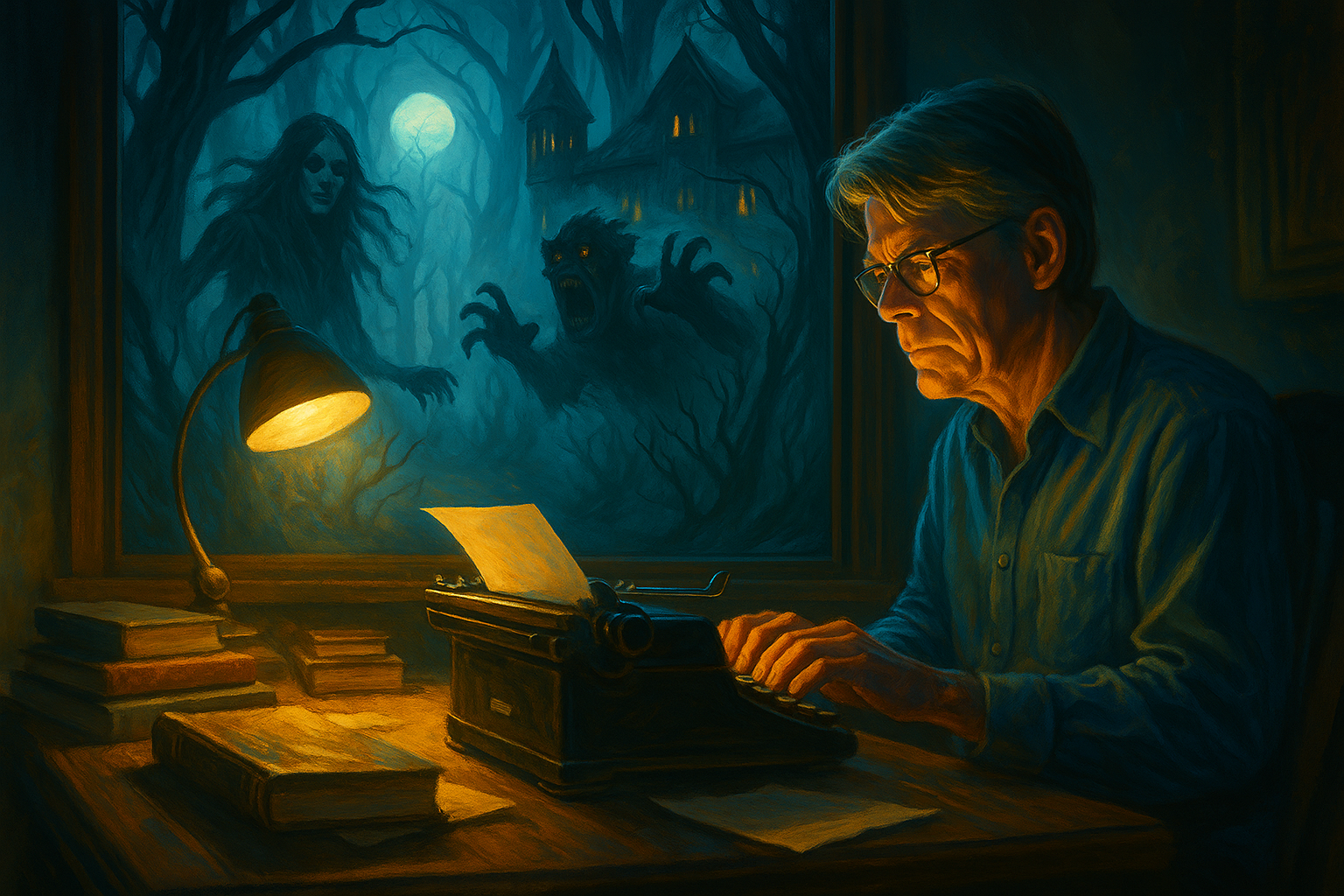
Horror as More Than Scares
Stephen King is globally known as “the King of Horror,” a writer whose name instantly evokes dread, dark corridors, haunted towns and monstrous terrors. Yet the paradox at the heart of his fame is that while horror frightens most of us, King — and millions of horror fans — are drawn to it. We pay for tickets, stay up late reading, or devour stories with uneasy thrill. What compels us toward fear?
Horror is more than just fleeting scares. For King, horror is a lens — a way to explore the deepest, strangest corners of human fear and experience. It’s a genre that doesn’t just celebrate shock or gore; it confronts what we prefer to hide. Horror gives us a chance to see what lurks behind closed eyes, beneath the comfort of normal life, and inside quiet minds. The monsters are often metaphors — for regret, guilt, trauma, mortality, social injustice, inner demons.
Thus, horror becomes a mirror — it reflects not only external terrors, but internal insecurities. It becomes catharsis — a way to channel repressed fears and anxieties. And it becomes confrontation — a controlled space where we face darkness, then return to normalcy, changed, relieved, aware.
This article argues that King embraces horror because it is a profound tool — not for gratuitous fear, but for emotional exploration, mental cleansing, and psychological truth. Horror is not our enemy — it is a teacher. It reveals fragile humanity, tests courage, and allows us to emerge stronger.
Horror & the Human Psyche — Facing Inner Fears
In his celebrated essay Why We Crave Horror Movies, Stephen King begins provocatively: “I think that we’re all mentally ill; those of us outside the asylums only hide it a little better.” Dr Mark Womack+1 He doesn’t say this for shock — he says it to shine light on a universal truth: deep inside every human, there lurk impulses, fears, anxieties, and darkness. Horror offers a canvas to paint those hidden nightmares — safely, through fiction.
Horror allows us to externalize subconscious fears. The fear of death. The fear of loss. The fear of the unknown. The fear of being alone or losing control. These are not just phobias — they are existential anxieties that many of us carry silently. Horror stories give shape to those intangible terrors; they allow us to face what we dread but rarely acknowledge.
Because human fears are universal — mortality, isolation, moral failure — horror has global resonance. A haunted house in Maine, a spirit in a remote village, a maddening obsession in a small town — no matter the cultural backdrop, horror taps into feelings we all share. That’s why horror fiction travels across languages and cultures; it speaks a primal human language.
Rather than repressing these fears, horror encourages their confrontation. It gives a safe space to acknowledge them without judgement. In witnessing terror externally — on screen or page — we attain awareness. We examine our vulnerabilities. And once the story ends, we carry the lessons, the courage, or the relief into real life. Horror becomes not escapism, but psychological exploration.
Horror As Catharsis — Release of Repressed Emotions
One of the core arguments King presents in “Why We Crave Horror Movies” is that horror functions as a kind of psychic release valve. In modern life, societal norms often repress extreme emotions — rage, panic, terror, grief, despair. Horror lets us experience those extremes in a controlled environment, give them shape, and then release them. englit.org+1
Like riding a roller coaster, horror gives a jolt. The heart races, the palms sweat, the mind drifts toward “what ifs.” But once the ride is over, there is relief, catharsis, even gratitude. By confronting fears in fiction, we remind ourselves that evil, danger, suffering can be externalized — and we often survive. Horror resets our emotional baseline, allowing suppressed dread to surface, be acknowledged, and then fade.
This confrontation also creates contrast. After experiencing horror’s darkness, the light — safety, warmth, love, normal life — feels more precious. Simple comforts become meaningful again. Close relationships, everyday routines, ordinary kindness — these resurface with renewed value. Horror helps us remember that peace is fragile but precious.
Moreover, horror’s emotional cleansing is not just for individuals. Shared experiences — watching horror with friends, discussing unsettling scenes, voicing fears — create communal empathy. We realize we are not alone in our anxieties. We learn that fear is human, but so is hope.
In this way, horror becomes therapeutic. It doesn’t glorify terror — it serves as a mirror to our fears, a release for pent-up tension, and a tool for emotional truth. For King — and for many of us — horror is not just entertainment; it’s an act of psychological honesty.
Horror as Social Mirror — Reflecting Real World Terrors & Injustice
Horror doesn’t always require ghosts or monsters. Sometimes its greatest power lies in truth wrapped in fear, in reflecting the real horrors of human society. Writers like Stephen King use horror not only to scare, but to critique the darkness within humanity — cruelty, injustice, prejudice, moral decay.
In these stories, horror becomes allegory. A haunted town may symbolize systemic oppression; a monster may represent corruption or moral degeneration. By externalizing such horrors, horror fiction forces us to see — and confront — problems we often pretend don’t exist. Fear becomes a tool of awareness, anxiety a messenger for change.
Because societies evolve, horror adapts. In past decades, horror narratives explored supernatural evil; today, they reflect modern anxieties — pandemics, isolation, environmental collapse, social inequality. Horror reminds us that real-life terrors are often worse than any invented monster.
Moreover, horror makes empathy possible. When we read or watch characters facing discrimination, injustice, or fear, we experience a fraction of their trauma. Horror prepares us to understand pain beyond our own lives. It bridges empathy across cultures, backgrounds, and experiences. Psychological horror — focusing on internal trauma and mental anguish instead of gore — especially excels in this.
Ultimately, horror’s greatest power may not be terror — but truth. It reveals what we hide, challenges what we accept, and wakes us to the darker corners of humanity. Stephen King doesn’t just want to scare — he wants us to look away from the monsters we imagine, and look instead at the monsters we ignore.
Crafting Fear — The Art of Suspense and Storytelling
What sets good horror apart from cheap scares is craft — the slow-building tension, the creeping dread, the psychological pressure that lingers long before the monster appears. Stephen King himself laid out a hierarchy of fear in his book Danse Macabre: terror, horror, and revulsion — in that order of emotional potency.
Terror is the finest of the three. It’s that unsettling, anticipatory dread — when you sense something is wrong but don’t know what. A creaking floorboard in a silent house, a shadow that flickers just at the edge of sight, or footsteps beyond the wall at midnight. That stretch of uncertainty awakens our primal instincts and charges imagination — often far more terrifying than any revelation. King believed that when done right, terror “expands the soul,” heightens every sense, and leaves the reader staring at empty corners long after the page ends.
If terror fails, horror takes over — the moment when the unknown becomes known, when the monster shows, when dread transmutes into shock. It jolts us awake. Finally, revulsion appeals to the physical — the gore, the repulsion, the stomach-churning cruelty. King acknowledged that revulsion is the least lofty of these tools, the “gross-out,” resorted to only when terror and horror won’t suffice.
But King’s work reminds us that horror is not just about frightening us. It’s about awakening our imaginations, forcing us to feel deeply, to question our morality, to examine hope in the face of despair. For him, horror is a storytelling medium — not an end in itself, but a tool to explore human nature, moral ambiguity, suffering and redemption. Underneath the scares lies empathy, truth, and gothic reflections of real human terrors.
When horror is crafted carefully — with dread before appearance, psychological nuance over shock, moral conflict over gore — it becomes literature. It becomes a mirror to our own fears.
Horror’s Hope — Light in the Darkness
Too often, horror is misunderstood as nihilistic, as celebrating evil or cruelty. But with Stephen King, and many profound horror stories, darkness is meant to magnify — not glorify — our humanity. Horror provides a unique paradox: it presents fear, but often ends with resilience, hope, or at least survival. It shows us evil — so we recognise good. It tests morality — so we appreciate virtue.
King’s stories — even at their darkest — often carry threads of humanism. Ordinary people thrown into terror respond not merely with fear, but with love, empathy, courage. They fight internal demons and external horrors, often at great cost, but they fight. This is not just sensational horror — this is horror that reveals what it means to be human.
Horror offers a safe confrontation with fear. By witnessing terror or monstrosity on page or screen, readers and viewers explore their deepest anxieties from the safety of their armchairs. When the story ends, the lights come on, the world seems more forgiving — because we emerge with gratitude for the ordinary, love for life, and empathy for suffering. Horror becomes a purification ritual: it forces emotions to vent, then lets peace return.
Ultimately, horror’s purpose isn’t to celebrate evil — it’s to remind us that evil exists, that fear is real, and that goodness, compassion and human connection are precious precisely because they exist amid darkness. Horror teaches: we survive. We endure. And through endurance, we remember the worth of kindness, love, and courage.
Horror as a Mirror to Humanity’s Soul
Horror’s power lies not in grotesque scenes or cheap jump scares — it lies in its ability to reflect our deepest fears, our moral dilemmas, our fragility, and ultimately our strength. This genre begs us to look into the dark corners of our psyche, into the fractures of society, and into the pain often hidden behind quiet facades. But in doing so, it also offers a chance for transformation — catharsis, healing, growth.
Stephen King doesn’t write horror just to scare — he writes to reveal. He writes to show that monsters aren’t always supernatural; sometimes they are grief, guilt, pain, injustice — the shadows within. His work reminds us that horror is universal because fear is universal, and that confronting fear can awaken bravery.
In horror we learn that evil can be overcome, that darkness can be survived, that hope can emerge even from nightmares. Horror ends not necessarily in safety, but in awareness — awareness of vulnerability, awareness of strength, awareness of what it means to be alive and human.
Horror remains timeless because fear is timeless. And as long as people dream, hope, love — there will always be fear to reckon with. Horror helps us recognise the fear, understand it, and walk forward with deeper compassion, empathy, and courage.
Because true horror doesn’t only show what we fear — it shows what we value. And understanding what we value helps us understand ourselves.